Category: Internet

The Noosphere

Back in February, I briefly discussed the Global Conscious Project and the dot, and while I would like to explore these topics in greater depth, it would be good to provide a summary of the phenomenon it aims to measure, the noosphere.

Just as water on Earth is contained by the hydrosphere and life comprises the biosphere, the mind exists within an analogous domain called the noosphere. Translated from the Greek words nous or mind,1 and sphaîra or sphere,2 it refers to a “sphere of mind”3 or a “thinking layer” that evolved from living beings.4 As humans and their activities evolved over time, so too did the biosphere, creating a relationship of co-evolution between the two as they continued to interact over time.5 It has also been described as “a global topology of human awareness emerging through recent technological and cultural interconnection.”6

The term was first developed in Paris in the early 1920’s by Vladimir Vernadsky, a Russian mineralogist, geochemist, and natural philosopher, who was delivering lectures on the biosphere, geology, and chemistry.7 These lectures inspired paleontologist Pierre Teilhard de Chardin and mathematician Édouard Le Roy, along with Vernadsky, to consider an additional, thinking layer to the planet that developed from the biosphere.8 Vernadsky was interested in the growing significance of human activity on the planet and suggested that humanity’s “collective reason” was influencing the evolutionary and geochemical processes on Earth.9 Specifically, it was “scientific thought” combined with humanity’s activities on Earth which developed a new stage in the planet’s evolutionary history.10

While they were in agreement that human culture and technology were the causal factors behind the development of the noosphere, each had their own specific sense of what the noosphere was.11 While Tielhard considered the noosphere to have certain mystical or spiritual qualities to it, Vernadsky considered it in a more materialistic sense.12 Le Roy’s views were said to be more similar to Tielhard’s, as both men were Catholic and shared an interest in topics which could bridge their religious beliefs with scientific research.13

Today, the noosphere is not a very popular idea in Western countries,14 but remains as a topic of interest in Russia15 and Ukraine.16 Contemporary discussions often involve sustainable development and environmental conservation17 and can be framed it in terms of living systems theory.18 As a superorganism, the noosphere can be characterized as being similar to other living systems like cells given the existence of functions or “subsystems” which process matter and energy, or information.19 When we consider the impact that the internet has had on both human societies and the biosphere,20 it seems intuitive to consider the noosphere as something very real and influential with respect to the planet and the organisms which inhabit it. Moreover, when we consider how social media on smartphones has increased connectivity and the ways we are able to reach others, through means like short videos, direct messages on social media, and tweets, this “thinking layer” of Earth seemingly continues to develop.

That being said, is there anything beyond our current technologies that contribute to or influence the noosphere? Maybe. The Global Consciousness Project claims that it is able to measure “collective consciousness” through the use of random number generators (RGNs).21 The idea is that “shared consciousness can cause the network to stop behaving in a random fashion” when “large numbers of people share a focused attention toward the same thing” or “smaller numbers of people are in a more coherent state and hold a collective intention.”22 Interesting.

While the Project is on its second generation of the RGN network,23 the first version and its corresponding website contained a visual representation of the data to indicate “conscious coherence.”24 The “dot” ranges in colour depending on the variance of randomly generated numbers detected within the network.25 A blue dot signifies a “significantly small network variance. Suggestive of deeply shared, internally motivated group focus” while on the opposite side of the spectrum, a red dot indicates a “significantly large network variance. Suggests broadly shared coherence of thought and emotion.”26 I used to check the dot once in a while, sometimes after events like January 6th 2021, but would go months or even a year without checking back. I never took it too seriously, but it was always fun to see what it was picking up. Today, as I write this, something is broken because it’s been stuck on grey for hours.

The term noosphere was brought to my attention by an old URL used for the first generation of the GCP. At one point, the website was hosted on noosphere.princeton.edu and while the Princeton address is no longer in use, it can be seen on the Wayback Machine. After learning about the Project and the dot, I became interested in the noosphere and whether what they claim to be measuring is actually real. I will write more on the GCP and how minds can supposedly influence RNGs in an upcoming blog post. It has something to do with quantum effects, presumably generated by minds, but I need to do more research.

Works Cited

1 David Pitt and Paul R. Samson, The Biosphere and Noosphere Reader: Global Environment, Society and Change (1998; Taylor & Francis Group, 1998), 4.

2 Boris Shoshitaishvili, “From Anthropocene to Noosphere: The Great Acceleration,” Earth’s Future 9, no. 2 (2021): 5, https://doi.org/10.1029/2020EF001917.

3 Valentina Voronkova, “The Formation of the Concept of Noosphere Development of Modern Society in the Conditions of Information Society,” Philosophy and Cosmology 16, no. 16 (2016): 179.

4 Clément Vidal, “What Is the Noosphere? Planetary Superorganism, Major Evolutionary Transition and Emergence,” Systems Research and Behavioral Science 41, no. 4 (2024): 614, https://doi.org/10.1002/sres.2997.

5 David Pitt and Paul R. Samson, The Biosphere and Noosphere Reader: Global Environment, Society and Change (1998; Taylor & Francis Group, 1998), 18.

6 Shoshitaishvili, “From Anthropocene to Noosphere,” 4.

7 Pitt and Samson, The Biosphere and Noosphere Reader, 26; Shoshitaishvili, “From Anthropocene to Noosphere,” 6.

8 Shoshitaishvili, “From Anthropocene to Noosphere,” 6; Vidal, “What Is the Noosphere?,” 614.

9 Jonathan D. Oldfield and Denis JB Shaw, “VI Vernadsky and the Noosphere Concept: Russian Understandings of Society–Nature Interaction,” Geoforum 37, no. 1 (2006): 148.

10 Oldfield and Shaw, “VI Vernadsky and the Noosphere Concept,” 149.

11 Vidal, “What Is the Noosphere?,” 6.

12 Voronkova, “The Formation of the Concept of Noosphere Development of Modern Society in the Conditions of Information Society,” 180; Pitt and Samson, The Biosphere and Noosphere Reader, 53.

13 Pitt and Samson, The Biosphere and Noosphere Reader, 51.

14 Vidal, “What Is the Noosphere?,” 614.

15 Oldfield and Shaw, “VI Vernadsky and the Noosphere Concept,” 146.

16 Voronkova, “The Formation of the Concept of Noosphere Development of Modern Society in the Conditions of Information Society,” 187; Sergiy Sonko, “Man in Noosphere: Evolution and Further Development,” Philosophy and Cosmology 22, no. 22 (2019): 51.

17 Sonko, “Man in Noosphere,” 68; Oldfield and Shaw, “VI Vernadsky and the Noosphere Concept,” 145.

18 Vidal, “What Is the Noosphere?,” 615.

19 Vidal, “What Is the Noosphere?,” 615.

20 Vidal, “What Is the Noosphere?,” 617.

21 “Global Consciousness Project 2.0,” accessed September 4, 2026, https://gcp2.net/about.

22 “Global Consciousness Project 2.0.” This information can be found by expanding the section posing the question ‘How can we observe the effects of consciousness?’

23 “Global Consciousness Project 2.0.” Found under ‘How does the GCP 2.0 network differ from its predecessor in GCP 1?’

24 “The Global Consciousness Project,” accessed September 4, 2026, https://global-mind.org/.

25 “Global Consciousness Project Dot,” accessed September 4, 2026, https://global-mind.org/gcpdot/.

26 “Global Consciousness Project Dot.”

Coherency

The Global Consciousness Project and the Dot that represents global consciousness coherence is another esoteric rabbit hole that I was introduced to a few years ago and meant to research further. I had forgotten about it until earlier today, and was reminded of it while browsing through my collection of mysticism memes. Anyway, the basic idea is that computer systems which generate random numbers can be influenced by human minds, and by analyzing the coherency of random numbers generated around the world, we can get an idea about the coherency of human consciousness. The dot changes colour based on the variance within the network of random number generators, but I’m not sure what it means when it goes red. How does a large network variance indicate “broadly shared coherence of thought and emotion”? There’s lots to read about on the GCP website, so stay tuned and I will be back next week with more information.

It’s hard to believe the first month of the year is already behind us. I hope 2026 is off to a good start for you. I’ve been working on my resolutions and have met a few goals I set for myself, like weekly blog posts, finishing the Christmas cats cross stitch, and mending a few pairs of pants. The week that just passed, however, was not a productive one. I struggled to find something to write about for today’s entry, didn’t do the sewing I had planned on doing, and skipped the exercising. The thing about progress, though, is that it’s not linear and tomorrow is always a new day. Consistency is key.

Mr. Plinkett’s Bookshelf

One of my favourite websites is etymonline.com because I find etymology useful for interpreting texts and understanding the intentions of the author(s). When I visited the site today, something caught my eye that I was not expecting to see: Doug and Mr. Plinkett

A connection between a character from YouTube and a website about etymology? How?

The bookshelf; how did RedLetterMedia get an image of Doug’s bookshelf? Doug is the creator of etymology.com and the blog post’s author, Talia, recognized it from video calling with him. She reached out to RLM on Patreon but has yet to hear back. If she does, I hope she provides us with an update.
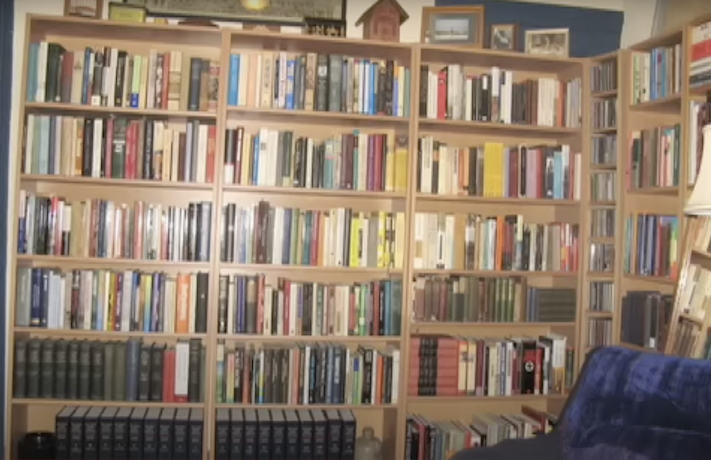

I cropped the YouTube screenshot from the blog post and ran it through the reverse-image search function on both Google and Bing. Google only finds the original image from the blog post and Bing doesn’t even find that. Given the video was originally uploaded in 2009, this is to be expected, since even if Mike had source the image from a different website, it’s unlikely that this website and the image are still up today.

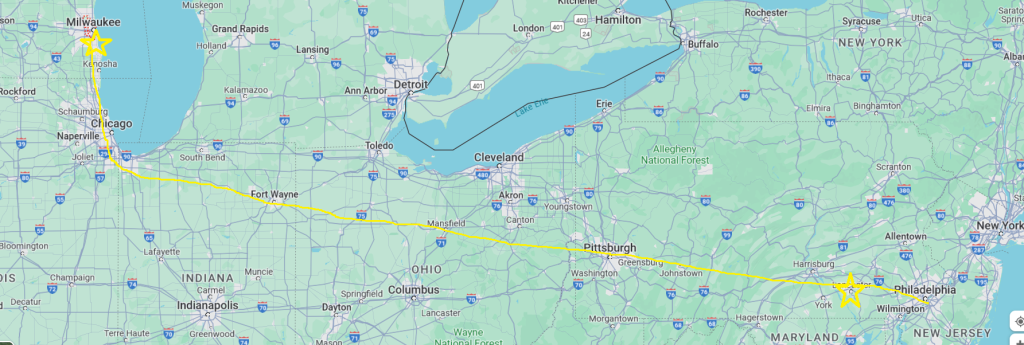
If we want to speculate further, one option is to think about whether they may know one another or have a mutual connection. According to Doug’s biography, he’s from southeastern Pennsylvania which is a fair distance from Milwaukee, so a personal connection is unlikely but is not impossible either. Did Mike have a video call with Doug at one point? Or did Rich or Jay source it through one of their connections? Do they even remember how the photo was found? We will have to see.

I like one comment by Sara posted at the bottom of the blog entry that reads “I’m a passionate fan of both Etymonline and Red Letter Media and this has made my day!” While I wouldn’t say that this discovery necessarily “made my day,” it is a humorous and unexpected moment. Especially considering I referenced one of their memes at the end of my qualia video.
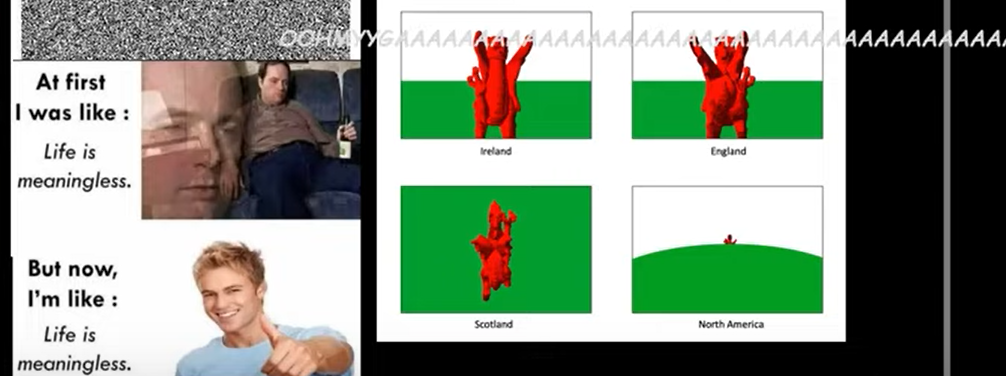

Here, Rich is featured in a philosophy meme about Nihilism and Existentialism. This one did make my day when I found it on Reddit years ago. The silly text overlay at the top is my addition and is one of many Richisms that have developed over the years. There are several RLMemes that have emerged actually; they’ve been at it a long time and appeal to a particular demographic which grew up alongside the internet. Given I am a part of this demographic, I also love internet mysteries, so cheers to one more.
Information Warfare

It seems we are in the midst of a new world war, except now it aims to lurk in the forms of soft power, coercion, and psychological manipulation. The Cold War essentially hibernated for a few years until Putin became powerful enough to relaunch it online by using Cambridge Analytica and Facebook, targeting major western superpowers like the United States and the United Kingdom. We are witnessing the dismantling of NATO as nations erode from the inside through societal infighting. War games are not mapped out on land and sea but in the minds of groups residing within enemy nations (Meerloo 99). By destabilizing social cohesion within a particular country or region, the fighting becomes self-sustaining and obscured.

Information is key for psychological operations; as sensing living beings, information is what allows us to make good decisions which allow us to achieve our goals and keep living as best as possible. Since information has the capacity to control the behaviours of individuals, power can be generated through the production and control of information. Today, a number of key scientific organizations and individuals are drunk with power as they are in positions to control what should be considered true or false. For the sake of resource management, and likely a dash of plain ol’ human greed, the pragmatic pressures of the world have shaped what was once a methodology into a machine that provides people with purported facts about reality. As a result, we are now battling an epistemic dragon driven by collecting more gold to sit on.

This suggests that the things we believe are extremely valuable to others around the world, in addition to being one of the most valuable things you possess. The information and perspective you can provide to others is valuable, either to the society you belong to or to those interested in seeing your society crumble. The adage about ideas “living rent free in your head” seems appropriate because cultural memes are causally effective; they shape the way you think and act and such, introduces a potential psychological harm. Critical thinking and introspection are important because they are processes which counteract the influence of other people, because by forcing individuals to dig deeper from their subjective point of view, one ends up consolidating and pruning their beliefs.

Collateral damage has shifted from bodies to minds and communities will continue to be torn apart until we develop a system for individuals to combat these external influences. Socrates has shown us that philosophical inquiry tends to irritate people, and the fact that mere scientific scepticism today is being met with ad hominems suggests we are on the right track. Remember, the goal is discourse rather than concrete answers, and an important component involves considering new and conflicting ideas. Be wary of what incentivizes other people but do not judge them for it. Compassion will be the most challenging part of this entire endeavour, but I believe in you.

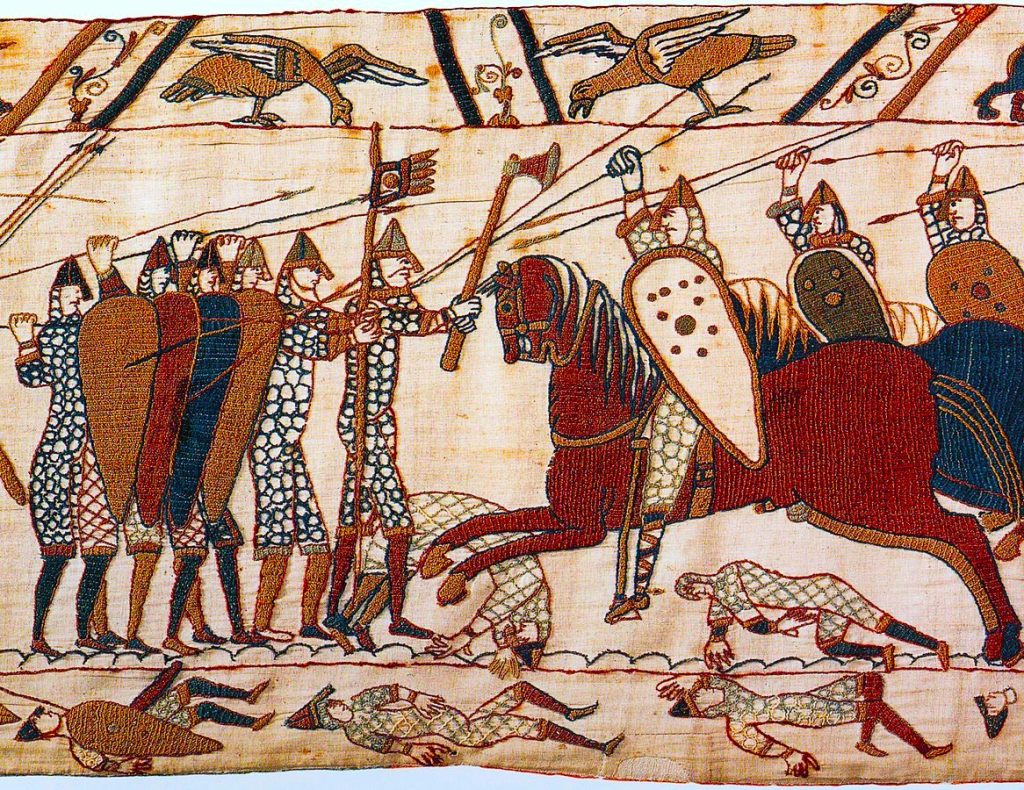
Bayeux Tapestry Scene 52

Works Cited

Meerloo, Joost A. M. The Rape of the Mind:  The Psychology of Thought Control, Menticide, and Brainwashing. The World Publishing Company, 1956.