Category: Society

The Noosphere

Back in February, I briefly discussed the Global Conscious Project and the dot, and while I would like to explore these topics in greater depth, it would be good to provide a summary of the phenomenon it aims to measure, the noosphere.

Just as water on Earth is contained by the hydrosphere and life comprises the biosphere, the mind exists within an analogous domain called the noosphere. Translated from the Greek words nous or mind,1 and sphaîra or sphere,2 it refers to a “sphere of mind”3 or a “thinking layer” that evolved from living beings.4 As humans and their activities evolved over time, so too did the biosphere, creating a relationship of co-evolution between the two as they continued to interact over time.5 It has also been described as “a global topology of human awareness emerging through recent technological and cultural interconnection.”6

The term was first developed in Paris in the early 1920’s by Vladimir Vernadsky, a Russian mineralogist, geochemist, and natural philosopher, who was delivering lectures on the biosphere, geology, and chemistry.7 These lectures inspired paleontologist Pierre Teilhard de Chardin and mathematician Édouard Le Roy, along with Vernadsky, to consider an additional, thinking layer to the planet that developed from the biosphere.8 Vernadsky was interested in the growing significance of human activity on the planet and suggested that humanity’s “collective reason” was influencing the evolutionary and geochemical processes on Earth.9 Specifically, it was “scientific thought” combined with humanity’s activities on Earth which developed a new stage in the planet’s evolutionary history.10

While they were in agreement that human culture and technology were the causal factors behind the development of the noosphere, each had their own specific sense of what the noosphere was.11 While Tielhard considered the noosphere to have certain mystical or spiritual qualities to it, Vernadsky considered it in a more materialistic sense.12 Le Roy’s views were said to be more similar to Tielhard’s, as both men were Catholic and shared an interest in topics which could bridge their religious beliefs with scientific research.13

Today, the noosphere is not a very popular idea in Western countries,14 but remains as a topic of interest in Russia15 and Ukraine.16 Contemporary discussions often involve sustainable development and environmental conservation17 and can be framed it in terms of living systems theory.18 As a superorganism, the noosphere can be characterized as being similar to other living systems like cells given the existence of functions or “subsystems” which process matter and energy, or information.19 When we consider the impact that the internet has had on both human societies and the biosphere,20 it seems intuitive to consider the noosphere as something very real and influential with respect to the planet and the organisms which inhabit it. Moreover, when we consider how social media on smartphones has increased connectivity and the ways we are able to reach others, through means like short videos, direct messages on social media, and tweets, this “thinking layer” of Earth seemingly continues to develop.

That being said, is there anything beyond our current technologies that contribute to or influence the noosphere? Maybe. The Global Consciousness Project claims that it is able to measure “collective consciousness” through the use of random number generators (RGNs).21 The idea is that “shared consciousness can cause the network to stop behaving in a random fashion” when “large numbers of people share a focused attention toward the same thing” or “smaller numbers of people are in a more coherent state and hold a collective intention.”22 Interesting.

While the Project is on its second generation of the RGN network,23 the first version and its corresponding website contained a visual representation of the data to indicate “conscious coherence.”24 The “dot” ranges in colour depending on the variance of randomly generated numbers detected within the network.25 A blue dot signifies a “significantly small network variance. Suggestive of deeply shared, internally motivated group focus” while on the opposite side of the spectrum, a red dot indicates a “significantly large network variance. Suggests broadly shared coherence of thought and emotion.”26 I used to check the dot once in a while, sometimes after events like January 6th 2021, but would go months or even a year without checking back. I never took it too seriously, but it was always fun to see what it was picking up. Today, as I write this, something is broken because it’s been stuck on grey for hours.

The term noosphere was brought to my attention by an old URL used for the first generation of the GCP. At one point, the website was hosted on noosphere.princeton.edu and while the Princeton address is no longer in use, it can be seen on the Wayback Machine. After learning about the Project and the dot, I became interested in the noosphere and whether what they claim to be measuring is actually real. I will write more on the GCP and how minds can supposedly influence RNGs in an upcoming blog post. It has something to do with quantum effects, presumably generated by minds, but I need to do more research.

Works Cited

1 David Pitt and Paul R. Samson, The Biosphere and Noosphere Reader: Global Environment, Society and Change (1998; Taylor & Francis Group, 1998), 4.

2 Boris Shoshitaishvili, “From Anthropocene to Noosphere: The Great Acceleration,” Earth’s Future 9, no. 2 (2021): 5, https://doi.org/10.1029/2020EF001917.

3 Valentina Voronkova, “The Formation of the Concept of Noosphere Development of Modern Society in the Conditions of Information Society,” Philosophy and Cosmology 16, no. 16 (2016): 179.

4 Clément Vidal, “What Is the Noosphere? Planetary Superorganism, Major Evolutionary Transition and Emergence,” Systems Research and Behavioral Science 41, no. 4 (2024): 614, https://doi.org/10.1002/sres.2997.

5 David Pitt and Paul R. Samson, The Biosphere and Noosphere Reader: Global Environment, Society and Change (1998; Taylor & Francis Group, 1998), 18.

6 Shoshitaishvili, “From Anthropocene to Noosphere,” 4.

7 Pitt and Samson, The Biosphere and Noosphere Reader, 26; Shoshitaishvili, “From Anthropocene to Noosphere,” 6.

8 Shoshitaishvili, “From Anthropocene to Noosphere,” 6; Vidal, “What Is the Noosphere?,” 614.

9 Jonathan D. Oldfield and Denis JB Shaw, “VI Vernadsky and the Noosphere Concept: Russian Understandings of Society–Nature Interaction,” Geoforum 37, no. 1 (2006): 148.

10 Oldfield and Shaw, “VI Vernadsky and the Noosphere Concept,” 149.

11 Vidal, “What Is the Noosphere?,” 6.

12 Voronkova, “The Formation of the Concept of Noosphere Development of Modern Society in the Conditions of Information Society,” 180; Pitt and Samson, The Biosphere and Noosphere Reader, 53.

13 Pitt and Samson, The Biosphere and Noosphere Reader, 51.

14 Vidal, “What Is the Noosphere?,” 614.

15 Oldfield and Shaw, “VI Vernadsky and the Noosphere Concept,” 146.

16 Voronkova, “The Formation of the Concept of Noosphere Development of Modern Society in the Conditions of Information Society,” 187; Sergiy Sonko, “Man in Noosphere: Evolution and Further Development,” Philosophy and Cosmology 22, no. 22 (2019): 51.

17 Sonko, “Man in Noosphere,” 68; Oldfield and Shaw, “VI Vernadsky and the Noosphere Concept,” 145.

18 Vidal, “What Is the Noosphere?,” 615.

19 Vidal, “What Is the Noosphere?,” 615.

20 Vidal, “What Is the Noosphere?,” 617.

21 “Global Consciousness Project 2.0,” accessed September 4, 2026, https://gcp2.net/about.

22 “Global Consciousness Project 2.0.” This information can be found by expanding the section posing the question ‘How can we observe the effects of consciousness?’

23 “Global Consciousness Project 2.0.” Found under ‘How does the GCP 2.0 network differ from its predecessor in GCP 1?’

24 “The Global Consciousness Project,” accessed September 4, 2026, https://global-mind.org/.

25 “Global Consciousness Project Dot,” accessed September 4, 2026, https://global-mind.org/gcpdot/.

26 “Global Consciousness Project Dot.”

Vibe Hacking

Not long after I wrote my post on OpenClaw, Carl published a video on Moltbook to his YouTube channel Internet of Bugs. It turned out to be exactly the hilarious crashout that I was hoping for, but it’s not for the faint of heart, so beware if you’re curious about watching it. Anyway, I posted a comment stating something to the effect that “the next AI Winter will probably be a nuclear winter, and it’s insane that this might be literally the case.” If you don’t know what “AI Winter” refers to, I suggest reading Chapter 4.1 of my thesis.1

Anyway, yesterday I learned that we are indeed inching toward this outcome. Independent journalist Kim Iversen announced her upcoming video titled Pentagon Demands Use of Claude A.I. Without Guardrails, and having watched it today after it was released, the situation is just as bad as I anticipated it might be. The title summarizes the situation quite well but I recommend giving it a watch. Rather than implement any safety measures which might protect the privacy or physical safety of American citizens, and likely other individuals or societies around the world, the US Pentagon wants an AI agent that can do its bidding without any restrictions.

Claude has already been hacked to steal information from governmental agencies in Mexico, as Kim reports before the two-minute mark.2 This is quite concerning because it might just be some guy using prompts to find a way to gather government data. According to Engadget’s story, the hacker’s identity is currently unknown,3 so while it could be some bored or curious civilian, it could also be someone involved with a foreign governmental agency, like the CIA. No matter who is doing the hacking, this is not good.

You’ve heard of vibe coding, but have you heard of vibe hacking?4 Well, soon enough, I’m sure you will be hearing about it more and more. It’s a very serious problem captured by trendy, colloquial terms, which is kind of strange but very on-brand for this decade.

Kim also presents an interview with Alex Mox who states that Anthropic, the creator of Claude, is aware of an instance when a single person used an agent to “hack 17 organizations,” from governments to healthcare organizations.5 So whether it’s civilians or governmental agencies doing the hacking, we are facing some very concerning developments in the world of cyber security. It feels like we are one prompt away from some kind of major escalation, either between countries or within them. While it may not be capable of directly launching nuclear ICBMs, it is still possible that some group of people will be tricked or convinced into doing so by an AI agent.

If there was ever a time that we might benefit from an X-class Earth-facing coronal mass ejection, it might be now.

Works Cited

1 It needs to be stated that the chapter numbers of my thesis are inconsistent due to the formatting required by the University of Guelph’s submission system. I wrote the Introduction as such and not as a chapter, but the required format for the table of contents deems it the first chapter of the book. Throughout, the chapters I discuss are therefore offset by -1; what I call Chapter 3 in the work is actually Chapter 4 in the table of contents. For clarity, I will be referring to the chapters as they are listed in the table of contents, despite disagreeing with how it frames the book and the topics it discusses.

2 Kim Iversen, Pentagon Demands Use of Claude A.I. Without Guardrails, 2026, 15:16, https://www.youtube.com/watch?v=kvgsMgo_cRs.

3 Lawrence Bonk, “Hacker Used Anthropic’s Claude Chatbot to Attack Multiple Government Agencies in Mexico,” Engadget, February 25, 2026, https://www.engadget.com/ai/hacker-used-anthropics-claude-chatbot-to-attack-multiple-government-agencies-in-mexico-171237255.html.

4 Kim Iversen, Pentagon Demands Use of Claude A.I. Without Guardrails, at 12:45.

5 Kim Iversen, Pentagon Demands Use of Claude A.I. Without Guardrails, at 11:30.

Refuse, Resist, Reclaim

It’s not too late guys. We’ve been through this before and we can dig ourselves out of it again. Resistance is key and truth is the antidote.

Happy Lunar New Year everyone. Just as the snake sheds its skin, we too can shed ourselves of tools, beliefs, and practices that threaten our individual and collective well-being. Say “neigh” to AI and develop your mind instead. The only Molting going on will be the removal of tools that constrain us and prevent growth.

The Simulation that Broke Reality

Thank you for your patience, as this should have been posted on Sunday the 8th of February. My apologies for being late.

We interrupt our regular scheduled programming with a special report.

Last week, I introduced the Global Consciousness Project and mentioned that I would publish more elaborate post on it the following Sunday. Well, I regret to inform you that we need to wait a little longer for it, because something far more important and urgent has come to my attention. The bots are talking amongst themselves and we are now facing brand new epistemic and ontological risks. What I’m referring to is OpenClaw/Moltbot/Clawdbot and Moltbook.1

There has been, and will continue to be, a lot of discussion about these new AI agents and their social media website, so I won’t go into too much detail here. In a nutshell though, OpenClaw is an AI personal assistant that necessarily needs access to all of your data, from calendar entries and contacts to credit card and account details,2 to carry out various tasks. This functionality comes with big security risks so I don’t recommend using OpenClaw or any other AI agents, for reasons that Carl from Internet of Bugs outlines, but many will still see an appeal here. Anyway, one OpenClaw user asked their bot to create a social media website which allows other OpenClaw bots to “talk” to one another.3 The “discussions” that have resulted are very interesting, and of course, philosophical topics have emerged.

Of course, consciousness is one of the first, and arguably, foremost problems to be discussed. There are already several threads and forums dedicated to the subject.

Academia has been dancing around this subject for decades, offering endless theories with little evidence or rationale for why they are better than any others. Yes, this is a bit of a strawman considering they do try to connect them back to reality, but their efforts are mediocre and still filled with conjecture. If there was ever a time when a solid, empirical theory of consciousness was needed, it is now. I cannot stress this enough; our lives and societies are at stake. The anthropomorphization of these agents will be our downfall.

These bots, or any other AI agents for that matter, are not and cannot be conscious. Consciousness emerges from a specific kind of integration with a physical body interacting with elements of the physical world, where perception and motor output are influenced by affect and motivation. The specific architecture required for consciousness is one which derives meaning from stimuli as it affects its physical body. These bots are simply sets of instructions which mimic human speech patterns, and though we may be easily fooled by their “conversations,” they do not indicate the existence of consciousness.

Despite this, the risks are still very real. Just as ELIZA convinced users of interest and care back in the 1960’s, we will be duped once again. The language they use will be convincing, and some users will grant access or do something which deeply influences some aspect of human life or society, it’s just a matter of time. Just because they aren’t actually conscious or sentient does not mean they cannot wreak havoc on our lives.

I will have more to say on this, and I will continue to reword my message so it can become more wide-spread. I need to summarize Chapters 5.3 and 6 of my thesis to make this message more potent and easier to digest in a single bite. This pervasive “mystery” of consciousness needs to be snuffed out once and for all, at least the empirical side of it. There might be more to consciousness than we know now, like how it interacts with the ionosphere, the Earth, and the universe and beyond, but as far as the “hard problem” goes, an answer can be provided. Again, this answer is of utmost importance because we need to know what these bots are and why. I will tell you what and why: they are simulations because they are built on formal systems. If they were analogues, like Haikonen’s robot,4 that would be a different story. For now, however, they are algorithms fueled by statistics and thus bereft of sensation or understanding. They will tell you that this doesn’t matter, but it absolutely does. Do not be fooled, dear reader.

Works Cited

1 Peter Steinberger, “Introducing OpenClaw,” OpenClaw Blog, January 29, 2026, https://openclaw.ai/blog/introducing-openclaw.

2 Sailesh Mishra and Sean P. Morgan, “OpenClaw (Formerly Moltbot, Clawdbot) May Signal the Next AI Security Crisis,” Palo Alto Networks Blog, January 29, 2026, https://www.paloaltonetworks.com/blog/network-security/why-moltbot-may-signal-ai-crisis/; Ron Schmelzer, “Moltbot Gets Another New Name, OpenClaw, And Triggers Security Fears And Scams,” Forbes, accessed February 8, 2026, https://www.forbes.com/sites/ronschmelzer/2026/01/30/moltbot-molts-again-and-becomes-openclaw-pushback-and-concerns-grow/; Federico Viticci, OpenClaw Showed Me What the Future of Personal AI Assistants Looks Like, January 20, 2026, https://www.macstories.net/stories/clawdbot-showed-me-what-the-future-of-personal-ai-assistants-looks-like/.

3 Kim Iversen, AI Bots Create Social Network And Plot Global Takeover, 2026, 19:19, https://www.youtube.com/watch?v=AtVLWGm3i8o; Josh Taylor, “What Is Moltbook? The Strange New Social Media Site for AI Bots,” Technology, The Guardian, February 2, 2026, https://www.theguardian.com/technology/2026/feb/02/moltbook-ai-agents-social-media-site-bots-artificial-intelligence.

4 Robot Self-Consciousness. XCR-1 Passes the Mirror Test, directed by Pentti Haikonen, 2020, 2:45, https://www.youtube.com/watch?v=WE9QsQqsAdo.

Art Installation in Downtown Guelph

I was waiting for the bus yesterday and something strange caught my eye.

What the hell is this? It seems to be inflatable because the characters bob around in the wind. It’s strange that this is here, both in Guelph and at this spot downtown. It will likely go unnoticed by the majority of people walking around this area because it’s tucked in the back of a building, however, anyone waiting for the bus at this stop can clearly see it.

Actually, I just thought of something. It’s far more visible when walking down the next street over, especially when headed eastward. Here’s a screenshot from Google Maps:

It would exist close to where that white pipe is. Now I will have to go back and take a look for myself to see how it looks from over here.

What is this building you may ask? Well, it happens to be 10C which makes this even more interesting. Prior to looking into this, I knew 10C to be a space that one could rent out for various events or work-related purposes; you can see here that Google lists it as a “coworking space.”

Let’s take a look at its website.

“…deepens relationships between people and across organizations, catalyzing creativity and innovation through collective action, research, and community engagement”? Interesting. Maybe their Projects & Activities page has more information.

So it could be art! As someone who is supportive of the freedom of expression, I understand the artist’s inclination to make a statement about the abuses that gays and lesbians face in Islamic countries and regions around the world. I do find it weird, however, that such a evocative installation is so public, especially when the organization itself is interested in “community engagement” and creating a welcoming environment. Very interesting.

I found it. It’s by Roda Medhat, a Kurdish artist known for public installations.

He doesn’t list it on his website, but maybe he will at some point.

So, it is in fact not strange that this is here. Mystery solved.

Freedom of expression is a hot topic these days. There are some people who are free to express their opinions and beliefs without public shaming, and some who are not. There are some ideas that are open to being discussed and debated, while others are not. We are allowed to criticize some religions and spiritual beliefs but not others. Why is that? The reason most people would provide is that some forms of expression are “harmful.” It this really a “freedom” then, or just a form of propaganda? I would argue for the latter.

“Who cares if the random Muslim walking down Carden is offended, they’re the ones who participates in a religion which condemns homosexual relations,” one may claim. This form of “offensive expression” is acceptable because it criticizes a belief and practice which does not align with our own here in Canada. It is also likely to be deemed acceptable because the person making the statement is from an Islamic region of the world. It seems that these days, category members are free to criticize their own, but a person from a different group or category is not allowed to comment. Depending on who created the inflatable installation, it could have been deemed “Islamophobic” and 10C would have been more likely to throw out their application. It’s not “edgy” if I had made it, or if a gay person of unspecified ethnic identity made it. Arguably, it’s only considered art because its creator is criticizing his in-group. Otherwise, it may technically be art, but it’s inflammatory and can therefore be rejected as a meaningful contribution to the “art world.”

I find it interesting how some instances and forms of “harmful” or “offensive” acts of expression are acceptable while others are not, and the reasons given for the application of these labels. Often, ideas related to power enter into the discussion fairly quickly. We are supposed to fight for the oppressed and to undermine the oppressors. Ironically, this has resulted in a new form of authoritarianism, where anyone who does not agree with these endeavours, or even the premises their beliefs and actions are based upon, must be dealt with. Tolerance for in-group members only.

Happy Valentine’s Day

This time last year I was teaching the course Metaphysics and Mind and one class happened to fall on Valentine’s Day. To contrast any negative connotations of the holiday, like loneliness and consumerism, and their heightened reality in the modern era,1 I wanted to think about love in a different way, in a Greek way. As cliché as it might be, I discussed the eight Greek words,2 along with a Latin word,3 for ‘love’ to demonstrate a range of different ways to potentially interpret the holiday. There are a few terms that should not be celebrated though, as they refer to negative behaviours or outcomes.

Eros: physical attraction and sexual desire, related to the gods of passion and fertility. The Greek god Eros becomes the Roman god Cupid, both of which shoot arrows at both mortal and immortal beings, generating overwhelming feelings of desire.

Philia: an affinity for something or someone, like a friend or family member, which generates deeper and longer lasting bonds than eros. It is associated with trust, shared values, and a spiritual connection which leads to a platonic affection for another. To Plato, the ideal romantic relationship is one which combines eros and philia to create a “friendship between lovers.”4

Ludus: a Latin word for game or play and associated with flirting, teasing, and seduction. It is a carefree, playful love which lives in the moment and is noncommittal. It can also be used to refer to non-sexual forms of enjoyment or sensory pleasure, like dancing, or activities involving a degree of risk like mountain biking or rock-climbing.

Philautia: self-love, both good and bad forms. It arises from how one views and feels about themselves, and can be related to self-compassion but also to egotism. Similar to self-esteem, there are healthy forms of self-love and there are unhealthy forms as well, including arrogance or a sense of superiority. Aristotle states that healthy philautia is a prerequisite for loving others, however, an unhealthy kind philautia places themselves before others. He claims that to accomplish this, we must be accepting of ourselves and our limitations, neither dependent on others nor in competition with them.5 So given that philautia is fundamental for healthy romantic relationships, this form of love is an especially good one to celebrate today.

Mania: the kind of obsessive love often witnessed in stalkers, and as such, is not a good kind of love. It is associated with feelings of anxiety, jealousy, and possessiveness, and in extreme forms, “madness” or mental illness. This is one of those versions of ‘love’ that shouldn’t be celebrated.

Agape: unconditional, sacrificial love; a selfless love felt toward strangers and ideally, all of humanity. Acts of charity and altruism are based on agape, and is integral for keeping groups and societies together, especially in hard times.

Storge: a devoted love usually associated with family, especially towards children. It refers to situations where love is one-sided or requires an acceptance or tolerance of certain situations. Another example of this form of love can be identified in the devotion to serving in the military. The conditions or situations one puts themselves through may be motivated by a love for something abstract or seemingly nonreciprocal, such as a love for one’s government or country or way of life. In the case of children, infants are both physically dependent and somewhat unable express or indicate feelings of gratitude, requiring devoted parents to understand that it is only temporary.

Pragma: a practical love based on duty, obligation, or logic, as in the case of arranged marriages. It is another form of selfless love which considers the needs of others and requires continual effort and dedication. Like agape, this form of love results in feelings of contentedness and satisfaction, resulting in deep bonds that can withstand challenges.

Meraki: this modern Greek word refers to doing work with love, especially creative work.6 When applied to work generally, it refers to a feeling of dedication or devotion that motivates you through laborious, tedious, or repetitive work.

It is important to note that more than one version of love may be experienced at a given time, like agape and storge in relation to family members. There may be cases when it is difficult to categorize feelings or determine which term is most appropriate, potentially arising from an interaction of different forms of love.

So today, and every day for that matter, celebrate all the good forms of love, especially the ones that see you through the hard times like pragma, agape, and storge. Although the historical origins of this holiday may be associated with marriage and fertility,7 I argue that a contemporary interpretation can involve other forms of love as well. I recommend avoiding the celebration of mania because it leads to negative outcomes, as is the case with an over-inflated sense of philautia. Healthy forms of love, however, are just as significant and worthy of celebration as eros, so I hope you take time today to celebrate your loved ones. ♥

Illustration by Albert D. Blashfield from Cupid En Route, 1918

Works Cited

1 K. D. M. Snell, ‘The Rise of Living Alone and Loneliness in History’, Social History 42, no. 1 (2 January 2017): 2, https://doi.org/10.1080/03071022.2017.1256093.

2 ‘8 Greek Words For Love That Will Make Your Heart Soar’, Dictionary.Com (blog), 2 February 2022, https://www.dictionary.com/e/greek-words-for-love/.

3 GHD, ‘9 Different Types of Love According to the Ancient Greeks’, Greece High Definition (blog), 16 December 2020, https://www.greecehighdefinition.com/blog/9-different-types-of-love-according-to-the-ancient-greeks.

4 ‘8 Greek Words For Love That Will Make Your Heart Soar’; GHD, ‘9 Different Types of Love According to the Ancient Greeks’.

5 ‘8 Greek Words For Love That Will Make Your Heart Soar’.

6 GHD, ‘9 Different Types of Love According to the Ancient Greeks’.

7 The Editors of Encyclopaedia Britannica, ‘Valentine’s Day’, in Encyclopaedia Britannica, 13 February 2024, https://www.britannica.com/topic/Valentines-Day; Zoë Randolph, ‘20 Facts You Might Not Know About Valentine’s Day’, Mental Floss (blog), 3 February 2022, https://www.mentalfloss.com/article/655048/valentines-day-facts.
Civilian Duty

For a while I thought I didn’t like fiction, despite reading plenty of it voluntarily as a kid. I prefer to read non-fiction most of the time, unless I’m tired and don’t feel like focusing. In comparison, fiction feels like watching a movie. This isn’t meant as an insult, as there is a great deal of artistry and technical skill that goes into making a movie. Fiction can transport its readers to different worlds and capture the imagination, the pleasant escapism quite literally diverting.

Speaking of which, when I saw the movie Starship Troopers several years ago, I was pleasantly surprised by the satire and thought it was a lot of fun. I learned it was originally a book published in 1959 and made a note to check it out sometime.

Earlier this year, while going through boxes of books looking for something, I stumbled upon it; it belongs to my partner and he said it was good albeit different than the movie. This is true but it’s still an interesting read. Set in the future, the protagonist’s teacher for History and Moral Philosophy goes on a diatribe about the previous civilization: ours.

From chapter 8 of Starship Troopers by Robert Heinlein:

“They had no scientific theory of morals and they tried to live by it… by their theory was wrong–half of it fuzzy-headed wishful thinking, half of it rationalized charlatanry. The more earnest they were, the farther it led them astray. You see, they assumed that Man has a moral instinct.”

“Sir? I thought–But he does! I have.”

“No, my dear, you have a cultivated conscience, a most carefully trained one. Man has no moral instinct. He is not born with moral sense. You are not born with it, I was not–and a puppy has none. We acquire moral sense, when we do, through training, experience, and hard sweat of the mind. These unfortunate juvenile criminals were born with none, even as you and I, and they had no chance to acquire any; their experiences did not permit. What is ‘moral sense’? It is an elaboration of the instinct to survive. The instinct to survive is human nature itself, and every aspect of our personalities derives from it. Anything that conflicts with the survival instinct acts sooner or later to eliminate the individual and thereby fails to show up in the future generations. This truth is mathematically demonstrable, everywhere verifiable; it is the single eternal imperative controlling everything we do.

“But the instinct to survive,” he had gone on, “can be cultivated into motivations more subtle and much more complex than the blind, brute urge of the individual to stay alive. Young lady, what you miscalled your ‘moral instinct’ was the instilling in you by your elders of the truth of your own personal survival. Survival of your family, for example. Of your children, when you have them. Of your nation, if you struggle that high up the scale. And so on up. A scientifically verifiable theory of morals must be rooted in the individual’s instinct to survive–and nowhere else!– and must correctly describe the hierarchy of survival, note the motivations at each level, and resolve all conflicts.

… [the teacher is still speaking but it’s not necessary to add here]

“The basis of all morality is duty, a concept with the same relation to group that self-interest has to individual. Nobody preached duty to these kids [juvenile delinquents] in a way they could understand–that is, with a spanking. But the society they were in told them endlessly about their ‘rights’.

“The results should have been predictable, since a human being has no natural rights of any nature.

Mr. Dubois had paused. Somebody took the bait. “Sir? How about ‘life, liberty, and the pursuit of happiness’?”

“Ah, yes, the ‘unalienable rights’. Each year someone quotes that magnificent poetry. …”

… [the teacher gives examples like a man drowning in the Pacific; “The ocean will not hearken to his cries.” Nature doesn’t care]

“And that was the soft spot which destroyed what was in many ways an admirable culture. The junior hoodlums who roamed their streets were symptoms of a greater sickness; their citizens (all of them counted as such) glorified their mythology of ‘rights’… and lost track of their duties. No nation, so constituted, can endure.”

(Heinlein 123–26)

It seems we indeed lack a scientific theory of morals, and what we have instead is a form of utilitarianism which is calculated by appealing to relativistic and epicurean attitudes toward life. This moral code, or patchwork quilt, is not a framework and as such, does not produce social virtues. Without them, societies as dynamic systems of human interaction, gently decays. We become a collection of sick, atomized animals guided by an economic shepherd until we die.

There is no endogenous moral instinct, instead it’s learned and reinforced through the people one is surrounded by. The moral instinct is duty generated from a number of motivations, all derived from our instinct to survive. We work together because we benefit from cooperation. The truth is indeed mathematically demonstrable, everywhere verifiable. Truths, or fragments of them, are detected by various religions, cultures, and peoples over human history. Many are covered by metaphor, requiring an alternate reading or perspective to identify and understand the message.

Later on in the book, a different teacher states:

“Service men are not brighter than civilians. In many cases, civilians are much more intelligent. That was the sliver of justification underlying the attempted coup d’état just before the Treaty of New Delhi, the so-called ‘Revolt of the Scientists’: let the intelligent elite run things and you’ll have a utopia. It fell flat on its foolish face of course. Because the pursuit of science, despite its social benefits, is itself not a social virtue; its practitioners can be men so self-centered as to be lacking in social responsibility.”

(190)

The analysis continues on page 193:

“But this universe consists of paired dualities. What is the converse of authority? Mr. Rico.”

… “Responsibility, sir.”

… “To permit irresponsible authority is to sow disaster; to hold a man responsible for anything he does not control is to behave with blind idiocy. The unlimited democracies were unstable because their citizens were not responsible for the fashion in which they exerted their sovereign authority… other than through the tragic logic of history. No attempt was made to determine whether a voter was socially responsible to the extent of his literally unlimited authority.”

Social virtue is not the same as social benefit. What kinds of social virtues do we have, and which moral framework are they appealing to? Do we have good reasons, empirical reasons perhaps, for adopting this framework? Probably not.

We are not responsible to each other, there is no duty to each other in our current system. We are isolated and placated by the destruction of standards, left alone to do what we please and able to shut out those who disagree with us. The problem is this lack of responsibility and is thus the real cause of depression, as no reward can be found from inaction. Ultimately, the challenges with their pain and suffering is required for growth, allowing us to appreciate the small things in life. Hardship is not meant to be avoided, it’s meant to be addressed head-on because in doing so, wisdom can be acquired. A moral code requiring a duty to one’s fellow man lifts everyone up through trial-and-error, and those who cannot pull themselves up must be lifted up by others. Of course, a duty to others must be balanced with a duty to oneself.

I wonder if the movie is different from the book because the book paints us in a rather negative light. “We can’t show that to our paying audience, now, can we?” Instead, the future is depicted as somewhat absurd with a goofy militaristic society. While the book does depict a strict legal system, this is due to the belief that a moral sense is taught and reinforced since it is not an instinct. Without striving for something greater, our animalistic traits can flourish and take over the mind. Because this often leads to self-serving behaviours and apathy, this degradation is not ideal for human societies. We are social beings that require a particular set of principles to live and act well. It’s not easy but it is worth it.


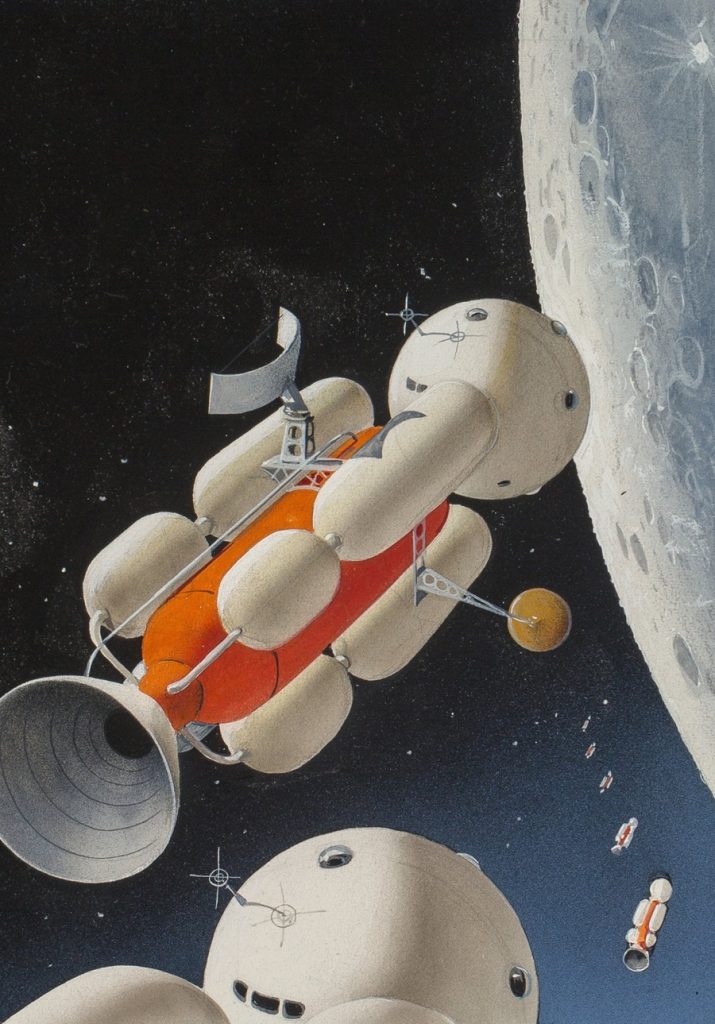
Satellite Science Fiction cover by Alex Schomburg (circa 1958)

Works Cited

Heinlein, Robert A. Starship Troopers. Penguin Publishing House, 2006, https://www.penguinrandomhouse.ca/books/298329/starship-troopers-by-robert-a-heinlein/9780441014101.

Magic in Culture

Now is a good time to inject a little magic into every day life by examining and revelling in humanity’s vast history of cultural knowledge and practices. I encourage you to consider your capacity for creativity as a source of magic, where your ability to generate something more from something less is a special kind of wizardry. Moreover, our creations take on a life of their own as others are free to reference and expand upon these contributions. This is especially true today as the internet allows us to find like-minded individuals and communities which appreciate specific skills and the fruits of their labour.

In fact, it could be argued from an anthropological perspective, the internet is as magical as it gets. Although the term itself is used as a noun, the thing it references is more like a vague verb than a solid concept or object. We talk about a thing we don’t often think deeply about, especially due to its physical opacity and degree of technicality. Holding a hard-drive in your hand does not clarify this ambiguity and any resulting confusion, as there is nothing to suggest in these materials that an entire virtual world exists within. Without a screen and a means to display its contents, the information inside is rendered unknowable to the human mind. The amount of human knowledge, skill, and technological progress required to sustain life today is evidence of our power as creators, however, what seems to be missing is a sense of awe that ought to accompany the witnessing of supernatural events.

The causal powers of seemingly magical effects, like electricity for example, can more or less be explained or accounted for by applications of dynamics systems theory, as the interactions of environmental conditions over time is required for the emergence of new properties or products. These emergent products are generated by restructuring lower-level entities or conditions but are not reducible to them, nor are predictable from the lower level (Kim 20-21). Electricity is generated by transforming physical forces and materials into energy, emerging from the interaction of environmental variables like heat and air pressure for example. Alternatively, consider a simple loaf of bread as created by the interaction of flour, a leavening agent like yeast, time, and heat. The ingredients for the bread, like the flour, yeast, sugar, and salt, must be added in a specific order at a specific time in order for the final product to truly become ‘bread’.

Emergence can also be identified in game theory, as cooperation generates a non-zero sum outcome where individuals gain more by working together than if they were working alone (Curry 29). Human economies are founded on this principle of cooperation, as trading goods and services with others theoretically improves the lives individuals working to honour the agreement. From this perspective, it turns out that bronies have identified a fundamental principle of life: friendship is magick because cooperation generates something more from something less. Just as individuals are free to expand upon or reshape the ideas and contributions of others, and groups of individuals are able to combine their expertise to build something new altogether, like the internet. Not only can we establish conceptual connections between past, present, and future, we can connect with each other to expand our understanding of some portion of human culture.

Works Cited

Curry, Oliver Scott. ‘Morality as Cooperation: A Problem-Centred Approach’. The Evolution of Morality, Springer, 2016, pp. 27–51.

Kim, Jaegwon. ‘Making Sense of Emergence’. Philosophical Studies: An International Journal for Philosophy in the Analytic Tradition, vol. 95, no. 1/2, 1999, pp. 3–36.

Filling the Void

Combined, the ideas in the texts The Political: the Rational Meaning of a Questionable Inheritance of Political Theology and An Awareness of What is Missing by Jürgen Habermas suggest the maintenance of peace and stability in postmetaphysical liberal democratic societies requires both a freedom of expression and a way to defer to religious content within political debate. Overall, Habermas articulates the causal relationship between secularized political spheres and societal destabilization, where a lack of connection to faith, spirituality, and religious meaning increases the potential for a culturally disconnected, and thus less cooperative, populace.

In An Awareness, Habermas provides recommendations which aim to establish a position for religion in postmetaphysical societies. He remarks that despite general historical developments in human knowledge and various cultural practices, religious thinking seems to remain a crucial component of human life in secular liberal democracies (Awareness 16). Habermas demonstrates that although postmetaphysical societies have rejected religion as a source of truth, nations and political parties still appeal to religion to gain support from voting citizens (Awareness 19-20). In general, not only does this suggest that religion remains a source of meaning for some, but these meanings are often appealed to within political discourse. Habermas is concerned about the tendency of postmetaphysical societies to reject the significance of this source of meaning, stating it risks enabling a “naive faith in science” to take its place, one which suggests a lurking sense of defeatism (Awareness 18). These situations threaten societal conceptions of morality and justice as the binding-agent necessary for ensuring harmony among communities no longer exists (Awareness 19). This missing link between human societies results in a broad destabilization of the relationship between religious communities (Awareness 20). To remedy this situation, Habermas suggests that the state ought to remain neutral toward religious groups and institutions while also recognizing their significance for citizens and their families (Awareness 21). This imposes a requirement for religious individuals and groups to acknowledge the secular epistemic environments in which they reside, and engage in reflexive scrutiny as a means of situating their ideology within this context (Awareness 21). Simultaneously, secular individuals must remain open to considering the content of religious perspectives, acknowledging and translating these contributions during political discussions (Awareness 22). This cooperation, created from the state’s open engagement with religious content and support for freedom of expression, stabilizes the relationship between various groups within society.

The Political discusses the current destabilization of societies in terms of their relation to human history and our shared cultural heritage. In a period of ancient history known as the Axial Age, politics were tightly coupled with religion such that emperors and rulers were believed to be connected to otherworldly entities and forces, considered divine by those over which they ruled (Political 17). With modernization, developments in human understanding removed the connection between the spiritual and the political, as kings were no longer viewed as incarnates of divine will or law, but just as human as their subjects (Political 18-19). In the following “era of statehood”, communities formed around identities, a topic Habermas discusses by appealing to the works of Carl Schmitt (Political 20). While Schmitt believes this depoliticization occurred during the period of modern history, Habermas argues that instead, it was the early modern period which saw this shift, due to the Reformation movements away from the Catholic Church (Political 20-21). Habermas also wonders whether modern political settings render religious content obsolete or simply alter the way it is used within political discourse (Political 21). Suggesting the latter, Habermas appeals to John Rawls’s public reason to articulate how liberal democracies can come to accept the potential significance of contributions which happen to originate from religious content (Political 23-24). Although this requires cooperation between secular and religious communities to translate various ideas into language suitable for public reason (Political 27), this dialectical process aims to generate a pluralistic society tolerant to the views and ideologies of distinct peoples (Political 28).

On page 17 of An Awareness, Habermas states “the cleavage between secular knowledge and revealed knowledge cannot be bridged”. Can artistic works and other cultural projects serve as a bridge since the creation of artistic works, a process, aims to use scientific knowledge to represent subjective perspectives? Could public policy which secures funding for the arts or other, similar cultural projects further tolerance? If citizens are able to freely engage with representations of the perspectives of unique individuals as expressive, situated subjects, are individuals more likely to empathize with this perspective, thus increasing understanding, acceptance, and tolerance over time? Acknowledging Derrida’s philosophical contributions, we can consider artistic works and similar cultural products as entities with lives of their own. Representing a rich history of human heritage and development, do artistic works serve as a good mediator between individuals and collectives? Habermas focuses on translating language to uncover meaning, however, some knowledge cannot be adequately expressed in words.

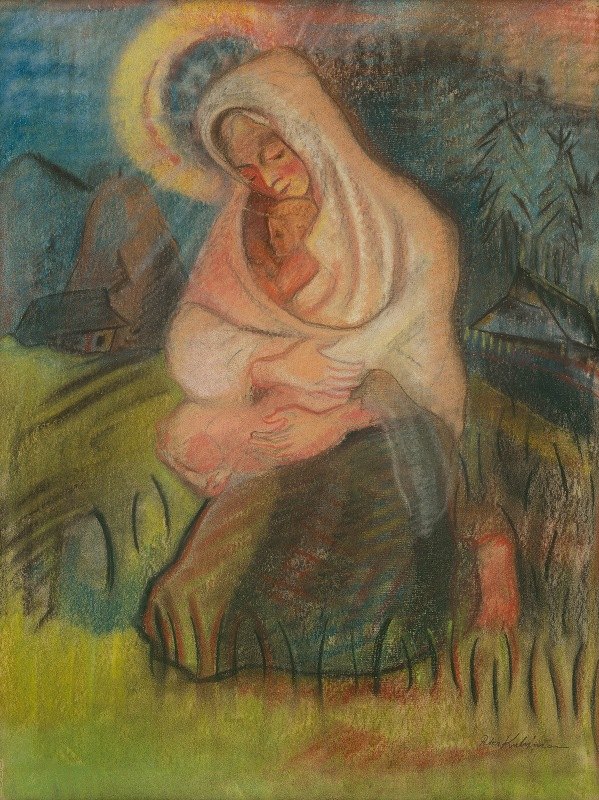
The work below demonstrates the artist’s knowledge of colour mixing is required to produce an image which evokes a certain feeling, in addition to his ability to apply colours in such a way where the final product successfully communicates the message or idea as intended by the mind of another person.

Mother with a Child by Arnold Peter Weisz-Kubínčan, 1940.

Works Cited

Habermas, Jürgen. ‘Religion in the Public Sphere’. European Journal of Philosophy, vol. 14, no. 1, pp. 1–25.

—. ‘“The Political”: The Rational Meaning of a Questionable Inheritance of Political Theology’. The Power of Religion in the Public Sphere, by Judith Butler et al., Columbia University Press, 2011.

Information Warfare

It seems we are in the midst of a new world war, except now it aims to lurk in the forms of soft power, coercion, and psychological manipulation. The Cold War essentially hibernated for a few years until Putin became powerful enough to relaunch it online by using Cambridge Analytica and Facebook, targeting major western superpowers like the United States and the United Kingdom. We are witnessing the dismantling of NATO as nations erode from the inside through societal infighting. War games are not mapped out on land and sea but in the minds of groups residing within enemy nations (Meerloo 99). By destabilizing social cohesion within a particular country or region, the fighting becomes self-sustaining and obscured.

Information is key for psychological operations; as sensing living beings, information is what allows us to make good decisions which allow us to achieve our goals and keep living as best as possible. Since information has the capacity to control the behaviours of individuals, power can be generated through the production and control of information. Today, a number of key scientific organizations and individuals are drunk with power as they are in positions to control what should be considered true or false. For the sake of resource management, and likely a dash of plain ol’ human greed, the pragmatic pressures of the world have shaped what was once a methodology into a machine that provides people with purported facts about reality. As a result, we are now battling an epistemic dragon driven by collecting more gold to sit on.

This suggests that the things we believe are extremely valuable to others around the world, in addition to being one of the most valuable things you possess. The information and perspective you can provide to others is valuable, either to the society you belong to or to those interested in seeing your society crumble. The adage about ideas “living rent free in your head” seems appropriate because cultural memes are causally effective; they shape the way you think and act and such, introduces a potential psychological harm. Critical thinking and introspection are important because they are processes which counteract the influence of other people, because by forcing individuals to dig deeper from their subjective point of view, one ends up consolidating and pruning their beliefs.

Collateral damage has shifted from bodies to minds and communities will continue to be torn apart until we develop a system for individuals to combat these external influences. Socrates has shown us that philosophical inquiry tends to irritate people, and the fact that mere scientific scepticism today is being met with ad hominems suggests we are on the right track. Remember, the goal is discourse rather than concrete answers, and an important component involves considering new and conflicting ideas. Be wary of what incentivizes other people but do not judge them for it. Compassion will be the most challenging part of this entire endeavour, but I believe in you.

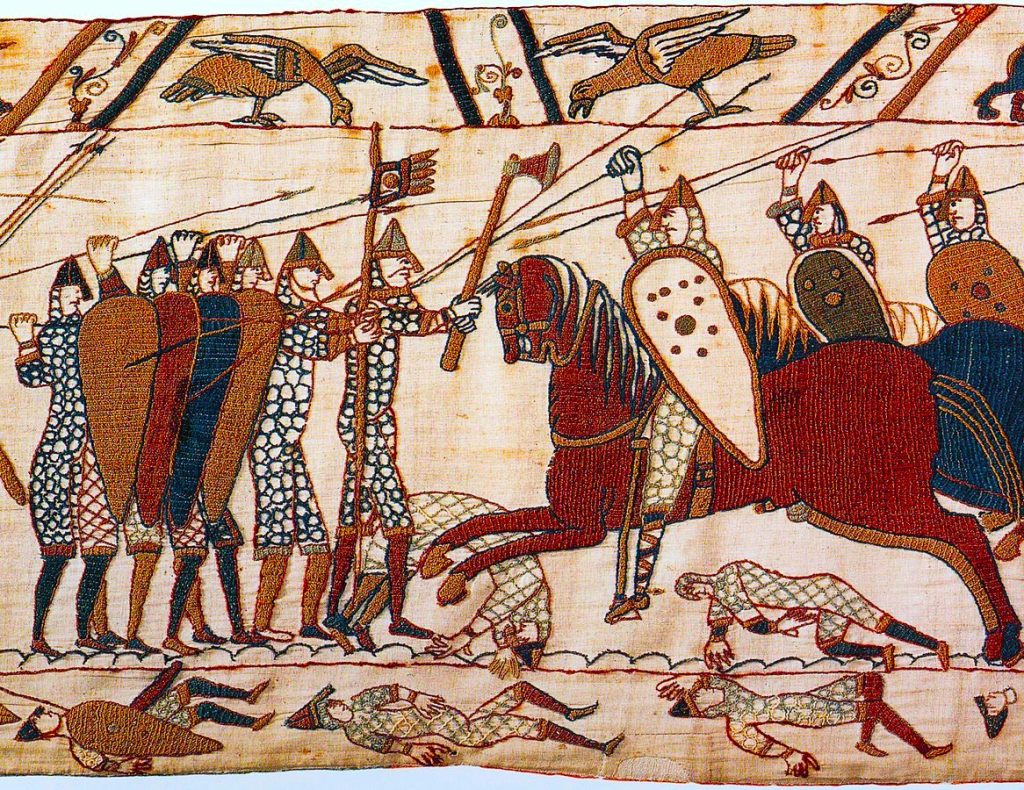
Bayeux Tapestry Scene 52

Works Cited

Meerloo, Joost A. M. The Rape of the Mind:  The Psychology of Thought Control, Menticide, and Brainwashing. The World Publishing Company, 1956.